REQUESTING AN EHC NEEDS ASSESSMENT

Ready to take the next step? Let's make the process clearer.
You've been looking into EHCPs and believe your child may need additional educational support. But how do you actually request an assessment? What information should you include? And what happens once you've submitted it?
You may feel that your child's needs aren't being fully understood, or that the support currently in place isn't enough.
You don't need to be a SEND professional to request an assessment. You just need to explain your concerns and why you believe your child's needs should be assessed.
This page provides free information to help you understand the process and begin preparing your request.
WHAT ARE YOU ACTUALLY REQUESTING?
The first step towards obtaining an EHCP is requesting an Education, Health and Care (EHC) needs assessment from your Local Authority.
This is a formal assessment of your child's educational, health and social care needs, and the provision that may be required to support them.
An assessment helps establish whether an EHC plan is necessary.
Requesting an assessment and receiving an EHCP are two separate decisions.
The Local Authority must first decide whether to assess. If an assessment takes place, it must then decide whether an EHCP is necessary.

CAN I REQUEST AN ASSESSMENT MYSELF?
Yes. You can request an EHC needs assessment directly from your Local Authority.
You do not need the school to submit the request for you or agree that an assessment is necessary.
The legal test considers whether:
Your child has or may have special educational needs.
It may be necessary for special educational provision to be made through an EHC plan.
You do not need to prove that an EHCP is definitely required before an assessment can take place.
You also do not need a formal ADHD or autism diagnosis, a particular level of academic delay or evidence that the school has spent a specified amount of money on support.
WHAT SHOULD I INCLUDE IN MY REQUEST?
Your request should help the Local Authority understand your child, the difficulties they experience and why you believe an assessment may be necessary.
1. Your child's needs
Explain what your child finds difficult. Consider communication, learning, emotional regulation, sensory processing, independence, relationships and attendance.
2. The impact of those needs
Describe what happens in everyday life. For example, your child may require substantial adult prompting, struggle to access lessons, experience significant distress or be unable to attend school consistently.
3. What support has already been tried
Include relevant interventions, adjustments, SEN Support plans and professional involvement, where available. Explain what has helped and what difficulties remain.
4. Why an assessment may be necessary
Explain why you believe your child's needs require further assessment and why provision through an EHC plan may be necessary.
Be specific, use real examples and include your child's strengths alongside their difficulties.
WHAT EVIDENCE CAN I INCLUDE?
You don't need to have every possible report before submitting a request.
However, relevant supporting information can help communicate your child's circumstances.
This might include:
SEN Support plans and provision maps.
School reports and attainment information.
Attendance and punctuality records.
Behaviour, incident or early-collection records.
Professional assessments and recommendations.
Information about interventions and their impact.
Relevant medical or diagnostic reports.
Your own written observations and examples.
Your child's views and experiences.
If you don't have all this information, you can still make a request. You can explain what is available and what further assessment you believe is needed.

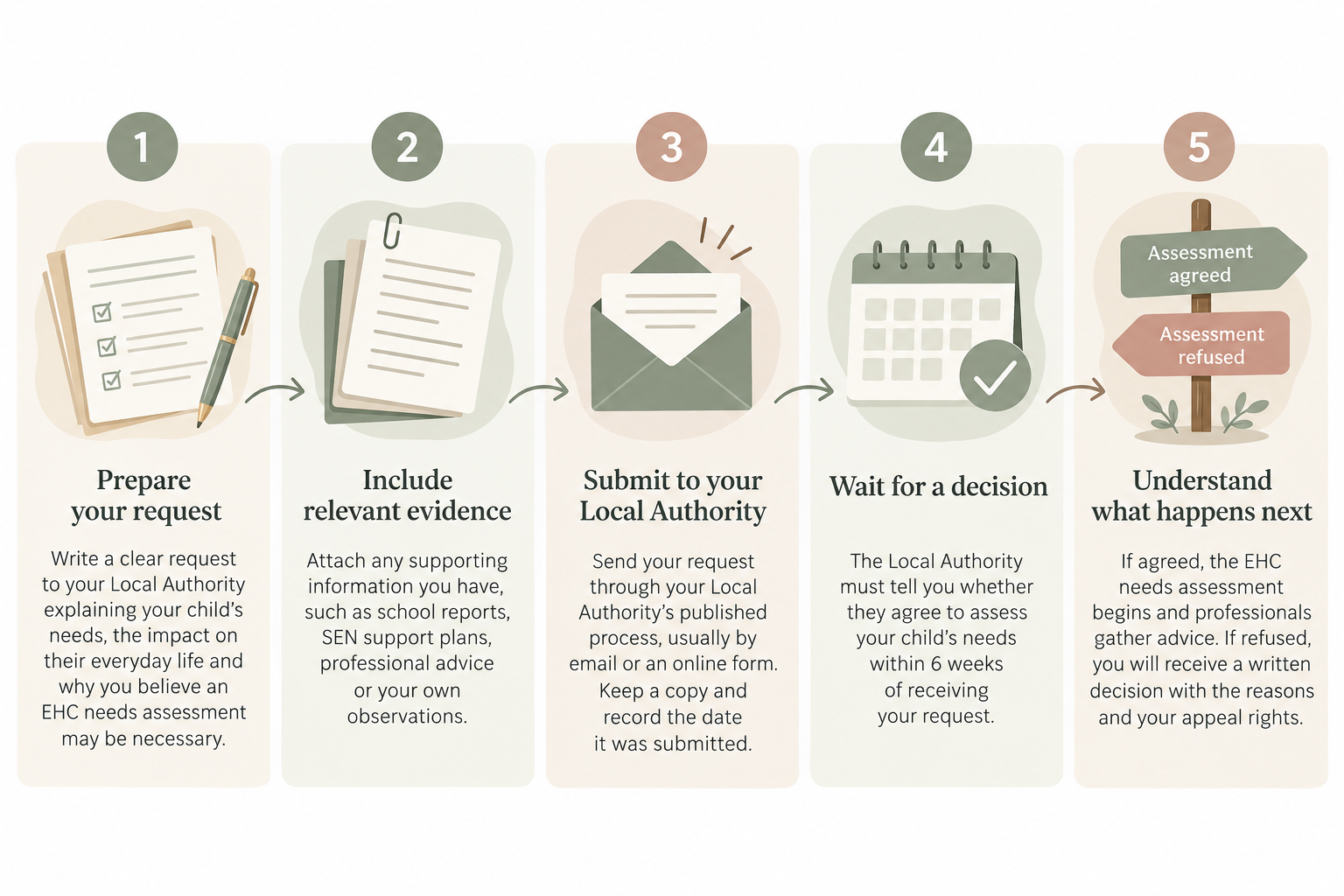
HOW DO I SUBMIT MY REQUEST?
Step 1: Find your Local Authority's SEND team
Visit your Local Authority's website and look for its EHC needs assessment request information. Some Local Authorities provide an online form or their own paperwork.
Step 2: Prepare your written request
Explain your child's needs, their educational impact and why you believe an EHC needs assessment may be necessary.
Step 3: Attach relevant evidence
Include the information you have available and keep copies of everything submitted.
Step 4: Submit your request
Send it through the Local Authority's published route and keep a record of the date.
Step 5: Wait for the assessment decision
The Local Authority must notify you of its decision within six weeks of receiving the request.

WHAT HAPPENS NEXT?
There are two possible decisions.
1) The Local Authority agrees to assess
The EHC needs assessment begins. The Local Authority gathers advice and information from relevant professionals, alongside your views and those of your child.
You will also be asked to contribute information about your child's needs, experiences and aspirations.
[NEXT STEP: COMPLETING YOUR PARENTAL CONTRIBUTION]
2) The Local Authority refuses to assess
You should receive a written decision explaining the refusal and your appeal rights. A refusal does not necessarily mean your child's needs are insignificant or that no further support is required.
You can seek independent information about your options, including through IPSEA or your local SENDIASS service.

WANT TO PREPARE YOUR REQUEST INDEPENDENTLY?
You may find these free resources helpful:
IPSEA – Asking for an EHC Needs Assessment
Information about the legal test, the assessment process and requesting an assessment yourself.
Your Local SENDIASS Service
Free, impartial information, advice and support about SEND and EHCP processes.

WOULD YOU PREFER PERSONALISED SUPPORT?
Let's build a clearer picture of your child's needs.
I understand how difficult it can feel when you're concerned about your child but aren't sure how to communicate those concerns or what information is important.
Through Sladen Advisory, I can help you review your child's circumstances, organise the information you have and prepare a clear, evidence-informed assessment request.
Support can include:
Reviewing existing school and professional documentation.
Identifying relevant needs and educational impact.
Helping you organise supporting evidence.
Supporting you to prepare your written request.
Identifying gaps in the available information.
Explaining the process and possible next steps.
EHCP Documentation Support
If you need more detailed assistance preparing your request, documentation support can be arranged according to your individual circumstances.
From £125 — scope and cost agreed in advance.

Start with a consultation
60-Minute Parent Support Consultation — £125
Ideal if you want to discuss your child's circumstances, understand the assessment process and identify what to do next.

A FINAL WORD FROM ME
Making an assessment request can feel like a big step, especially when you've already spent a long time trying to explain your child's needs.
Remember, your role isn't to diagnose every difficulty or have all the solutions.
Your role is to help build a clear picture of your child: who they are, what they find difficult, what support has been tried and why further assessment may be necessary.
You know your child. Your experience and observations are valuable evidence.
Melissa Sladen
Founder, Sladen Advisory
This page provides general educational information for families in England and does not constitute legal advice. Sladen Advisory cannot guarantee assessment decisions or EHCP outcomes.